

Donated items 2016-17
In April 2017 a letter written by Sidney Smith was kindly donated to the Collection by Mr. M. Barnett. He is a volunteer in the warehouse of a local charity which handles donations and the letter fell out of a donated book. He thought it was of interest and thought it should be preserved. The…

Tom Newman (1894 – 1943)
Six Times Billiard Champion Although born Thomas E. Pratt he played under the name Tom Newman and eventually changed his name to Newman in 1919. He played in the Professional Billiards World Championship finals in every year from 1921 to 1930. Winning the title six times. The last five of the finals were played against…

Peradon “The World’s Best Cue Maker”
(this was a message that Walter Lindrum wrote in a book to Fred Peradon in 1947) (also “1000 breaks in every cue”) The book “Billiards and Snooker by Walter Lindrum”, the World’s greatest Billiard player, was sponsored by Tooheys , it is an iconic Australian beer brand and brewery. The book had been in the…

Tournament Triangle
In March 2026 the Collection had donated the triangle used by the Tournament Match Referee Peter Williamson. Peter Williamson 26 July 1948 – 15th February 2026 Peter Williamson, a referee on the World Snooker Tour for 30 years until he retired in 2021. He died in 2026 after a period of illness at the age…

46/48 St. Anne Street
E. A. Clare & Son Ltd. building in Liverpool Whilst having major building work carried out on the 46/48 St. Anne Street premises, the building was surrounded in scaffold for many months. During the work old Lamb & Watts items turned up and a rainwater hopper with initials and a date, which made us interested…

Chares Dickens and Thurston
Dickens converted a room at Gads Hill Place into a billiard and smoking room. He even added special tiles to protect the walls from cue damage. The tiles that Dickens had fitted to his Billiard Room to prevent cue damage to the walls. January 1865 Jan 1866 Cheque for Billiard accessories Section of letter to…


SamsBros.
Whilst trying to research the history of Bar Billiards and its origins three U.K. business names come to the fore. Bar Billiards Ltd, Jelks and Sams Bros. These three business are the names originally associated with the introduction of the game of Bar Billiards into the U.K. Both Jelks and Bar billiards Ltd. have been covered


Geo. Wright & Co.
Sadly there is little in the Heritage Collection concerning this Billiard firm but with help from Peter Aisworth some salient details have been recorded and if any one can provide further information it would be of great interest. Currently the only picture of a table made by them is take


Burroughes & Watts
The main part of this article was written by Peter Ainsworth, the dedicated historian and researcher into all things written about the Billiard game. The information that he has put together for the article on this famous Billiard business is remarkable. Some of the pictures are from Peter Ainsworth others are from

E.J. Riley
An authoritative history of the E. J. Riley Ltd. business was written by the grandson of one of the founders of the business, which was published in the book – Billiards & Snooker a Trade History complied by Mr. J. R. Mitchell (the retired Managing Director of Thurston) and published by the British Sports & Allied Industries


File Returned by The Victoria & Albert Museum
In 2017 contact was made by the Victoria & Albert museum (V & A), they had recently found a file of Thurston papers and wished to return them. Some 30+ years earlier a number of files had been lent to the museum containing old drawings etc. but most had already been return. The file which the V & A found ha

Thurston’s Association With Napoleon
This article was prompted by Peter Ainsworth who had heard Peter Clare mention in a You Tube video by David Smith of Cuesnviews of the supply of Billiards equipment to St. Helena in 1819. This prompted further research as Peter Ainsworth had mentioned an article in the August 1925 edition of the Billiard Player.


E.A. Clare Son Ltd
As the oldest snooker / pool / billiard business on Merseyside in 2012 celebrated it’s 100th anniversary , the grandson of the founder has compiled some of it history complete with pictures of the personalities including the staff and managers over the years. The Company was founded in Fraser Street not half a mile from the current premises in St. Anne Street and so has been part of the local Everton district community for all its history.

G W Ellis – Ivory Turner
In September 2023 after Mrs. Gibbs (nee Ellis) had seen a repeat of the BBC programme “Flog it” which feature a visit by the presenter Paul Martin to the Snooker Heritage Collection. She phone in to say that she had some interesting items concerning Ivory Billiard Balls. Her father and grandfather had been in the b


The Construction of a Billiard Table
Most full sized Billiard tables stand on 8 legs. I think however we should perhaps immediately recognise that the legs and under framing of a Billiard Table are really only the physical means of supporting the playing surface at a convenient height above floor level.

Origins of The Game of Billiards
I am afraid nobody really knows how the game of Billiards really started, so it is that as with many other things in life there are a number of theories, or should I say “fairy tales” in existence which endeavour to explain the origin of the game, and you must choose whichever story you think best. One thing however is quite


Billiard & Snooker Balls
In previous articles we have traced the development of the billiard table from the early models with wooden beds and stuffed cushions, and we have traced the development of the billiard cue, from the original mace to the present day billiard cue, and we have also referred to the introduction of leather cue tips etc



Glass Cues
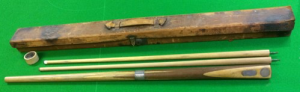
The earliest glass cue was made in the late 1920s to early 1930s. This was a time when cue makers were experimenting with other materials than wood. Thurston were one of the companies that were doing this. These early cue had a wire running inside the full length of the cue for strength, the glass had a yellow/green tinge to it.



Lancashire Billiard Handicap Scorecards 1920/30s
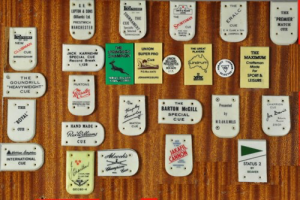
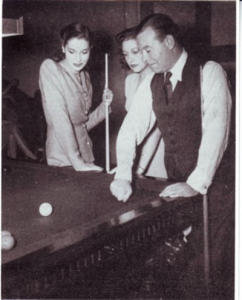
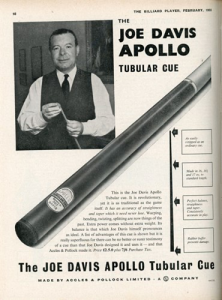
In August 2018 we received an email from Jenny Hill advising that she had about 20 score card/ programmes for Amateur Charity Billiard Handicaps for matches in Lancashire covering the late 1920’s and early 1930’s. She asked if they were of interest to the Collection.

Pontins Cup
A phone call from Bob Tonge, who for many years was the person who ran the North West Billiards & Snooker Association and even at 85 years of age still is a stalwart of the Bolton Association, asking if a home could be found to preserve one of the old North West Association cups. It has since been reclaimed by the association and is back in use


Pocket Net Information
In November 2017 a call was received from a Mr. Foster who had some information on a patent for Billiard Pocket Nets that allowed a referee or player to remove the balls from the net without having to put a hand into the net via the slate pocket opening. (It turned out that it was…
Pre-20th Century
A brief history of significant dates for the Company and some other interesting dates concerning the developments in Billiards & Snooker. 1799 – John Thurston established in Newcastle Street,St. Clement Danes, Strand, London as a Cabinet Maker and Billiards Table Maker . 1807 – The first leather cue tips used by Monsieur Mingaud -a retired French Infantry Officer…


The Snooker and Billiard Collection
The Norman Clare Collection, now called the Snooker Heritage Collection, at Thurston, St. Anne Street, Liverpool is probably the largest collection of billiards and snooker memorabilia in the world. Only the Heinrich Weingartner Museum in Vienna compare with it and that is devoted to carom billiards.


Bromborough Institute
An email was received on 3rd July letting E.A. Clare & Son Ltd. know that Bromborough Village Institute, built in 1908, had an ‘old’ Bayliff table which had a E.A. Clare remodel plate indicating that the last time it had been worked on was in 1954. Nothing really unusual in that BUT the table was stored under the floor.


Billiard/Snooker Table Beds
Prior to 1826 Billiard tables (when I mention a billiard table you can substitute the word Snooker!!) had wooden beds. These beds were by no means level and it is recorded that Thurston sent out their fitters to ‘flog’ the bed i.e. they went and tried to plane off the high spots. An example of a full size wooden bed is in the Collection and there is also an 8ft portable table with a wooden bed.

Billiard Cloth
When you hear or read the cloth that covers the slate and cushions of a Snooker (Billiard) table described as BAIZE you can almost hear the sharp intake of breath in Stroud (West of England – Strachan) and Pudsey (Hainsworth) where the last mills in the UK that produce Billiard / Snooker cloth are based. Why the intake of breath – well baize is a wool /cotton mix material used for covering card tables and notice boards, whereas the cloth used on Snooker tables is a specialist quality pure wool material with a raised nap and is a much more costly engineered product. A far superior material than baize!

Billiard Chalk
I should perhaps also briefly refer to the Billiard Chalk. It seems that chalk was used on the ends of cues even before the leather tips were used, in order to try and prevent or reduce miscuing. It is perhaps interesting to note that even today we use ordinary white chalk on the wooden chuck in a lathe in order to grip a Bowling Green Bowl firmly during the turning process. Originally the chalk used was white, but this made such a mess of the playing surface that the green and blue Chalks were introduced, which were not so noticeable on the green playing surface of the Billiard Cloth.


Billiard Irons
The Billiard Table iron is quite a heavy piece of kit weighing in at approx 8 kilos ( 17.62 lbs). The iron should be used after the cloth has been brushed to help lay the nap. It should not be too hot as this can scorch the cloth and like the brushing is always used from the baulk end to the top of the table. It is also recommended that the start position for using the iron should be varied across the baulk end so that the when the iron is at its hottest (after being taken off the heat) is not always placed on the table in the same position as this could also mean that the cloth could be ‘heat damaged’


End of content
End of content
